
RESULTS-ORIENTED PROJECT CONTROL: HOW TO INTERPRET PERFORMANCE AND ACT IN TIME
VALUE PROPOSITION
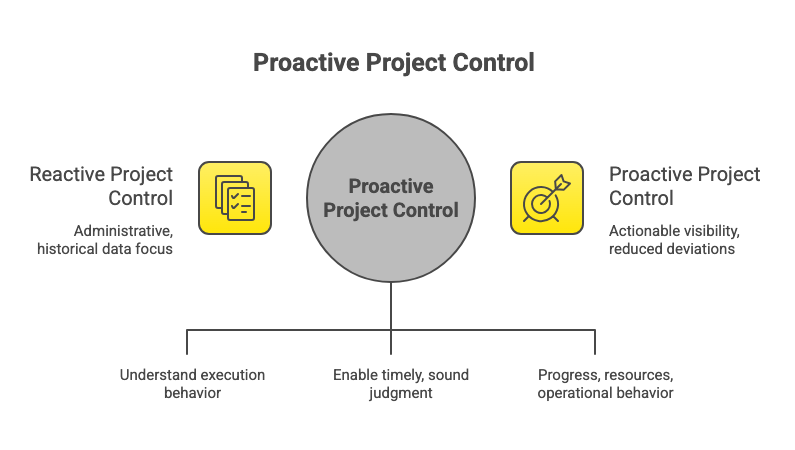
Project control ceases to be a mere administrative activity when it is geared toward interpreting actual performance and facilitating timely decisions. Moving beyond the simple consolidation of historical data, control becomes a system that enables an understanding of how execution is behaving and what implications it will have on project outcomes.
When analysis focuses on clear relationships between progress, resources, and operational behavior, the team gains the actionable visibility needed to act with sound judgment. This approach to managing control improves responsiveness, reduces exposure to deviations, and strengthens consistency in execution.
CONTROL AS A KEY MANAGEMENT TOOL
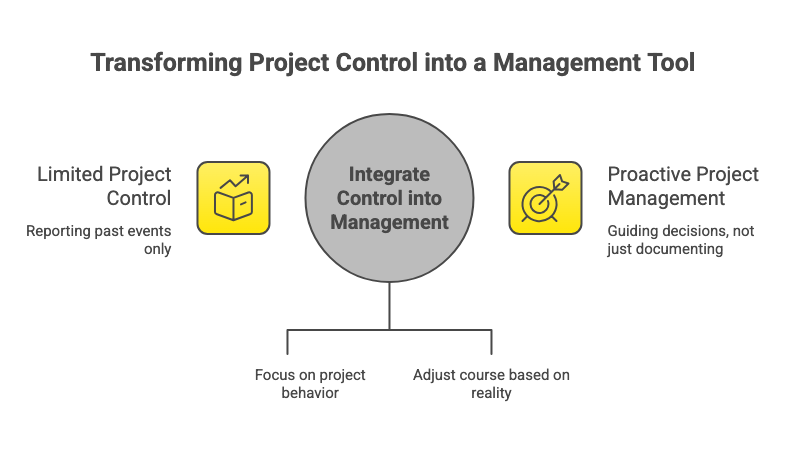
In many environments, project control is limited to reporting what has already happened. Figures are consolidated, indicators are presented, and compliance against the plan is validated. However, this approach describes a reality that can no longer be modified, reducing the practical value of the information generated.
A project can show aligned indicators while, at the same time, its execution is deteriorating. Historical information alone does not allow for an understanding of whether current behavior is sustainable, nor does it anticipate possible impacts.
Control gains value when it is used as a management tool. This implies prioritizing information that allows for the interpretation of project behavior, rather than simply documenting it. The quality of control is not measured by the number of reports, but by its capacity to guide decisions.
From this perspective, control is integrated into daily management. It ceases to be a periodic exercise and becomes a continuous mechanism that allows for the adjustment of the project’s course based on what is actually occurring.
INTERPRETING PERFORMANCE THROUGH OPERATIONAL RELATIONSHIPS
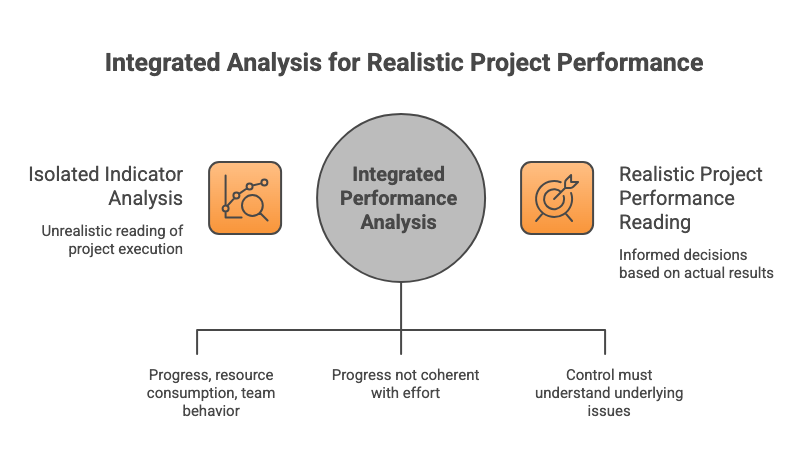
Project performance is not understood by looking at isolated indicators, but by analyzing the relationship between key variables. Progress, resource consumption, and team behavior must be interpreted in an integrated manner to obtain a realistic reading of the execution.
It is common to find situations where reported progress remains on plan, while resource consumption grows disproportionately. This disconnect usually indicates inefficiencies that are not evident in a superficial analysis.
Understanding these relationships allows for the early identification of inconsistencies. When progress is not coherent with the effort required, control must delve deeper into the causes rather than limiting itself to validating the result.
This type of analysis is aligned with performance-based management approaches promoted by organizations such as the International Organization for Standardization (ISO), particularly in standards like ISO 21502, which emphasize the importance of evaluating projects based on actual results and not solely on formal compliance.
TRENDS AS A BASIS FOR INFORMED DECISIONS
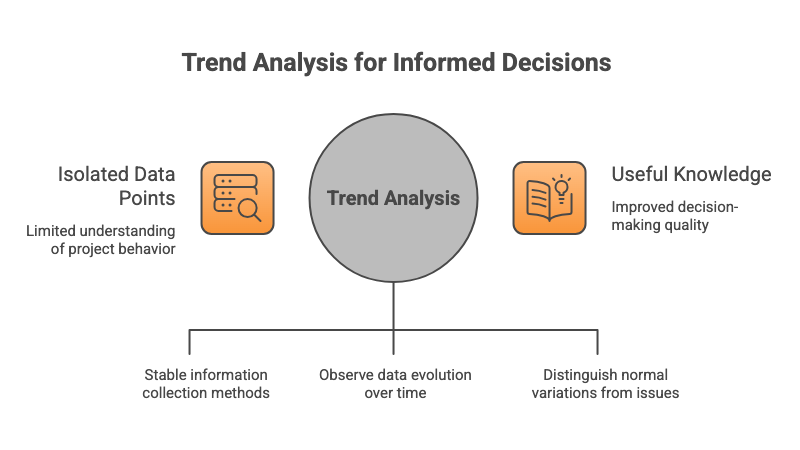
One of the most common limitations in management is the reliance on isolated data points. An indicator may reflect a correct situation at a specific moment, but it does not necessarily represent the project’s behavior over time.
Trend analysis allows for the identification of patterns that are not visible in an isolated measurement. A progressive decrease in productivity, a sustained increase in indirect costs, or changes in the sequence of activities are signals that can only be understood when observing the evolution of data.
Working with trends requires consistency in measurement. The way information is collected must remain stable to ensure that comparisons are valid. Without this consistency, the analysis loses its meaning. The interpretation of trends transforms information into useful knowledge. It allows for a distinction between normal variations and behaviors that require attention, thereby improving the quality of decisions.
EARLY DETECTION OF OPERATIONAL DEVIATIONS
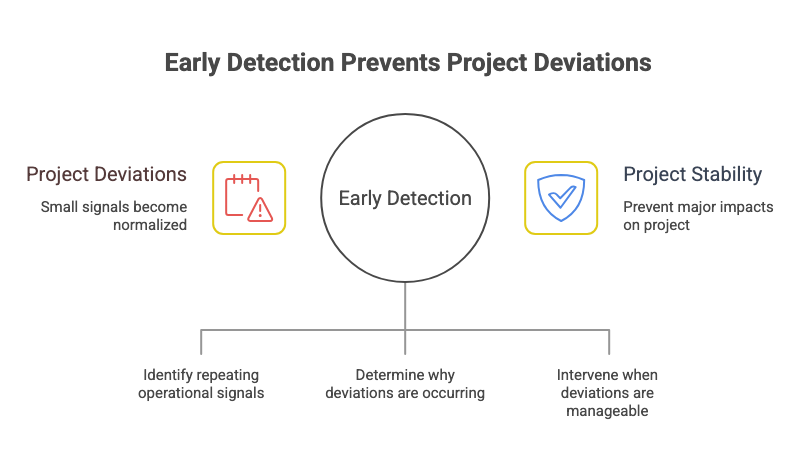
Project deviations do not usually appear abruptly. In most cases, they develop from small signals that recur and become part of daily operations.
These signals can manifest as frequent schedule adjustments, increases in indirect costs, delays in approvals, or a greater dependence on short-term solutions. When these situations become normalized, the project begins to lose control over its execution.
Early detection requires observing these patterns and understanding their origin. It is not just about identifying that a variation exists, but about understanding why it is occurring and what impact it may have on the project’s outcome.
The ability to act at this stage is decisive. Intervening when deviations are still manageable helps prevent major impacts on schedule, costs, and cash flow, thereby maintaining the project’s stability.
CONTROL AS A VALUE GENERATOR IN EXECUTION
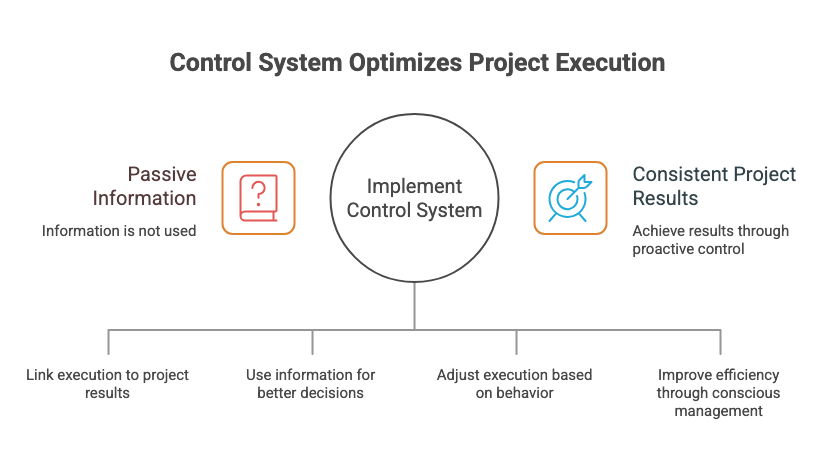
A well-focused control system allows for the connection of execution with project results. Information ceases to be a passive record and becomes an input for improving decision-making.
The ability to adjust execution based on observed behavior allows for the optimization of resource use and the improvement of operational efficiency. Control facilitates a more conscious management approach, where decisions are made based on relevant information.
Organizational analysis studies, such as those developed by McKinsey & Company on project execution topics, have pointed out that visibility into operational performance is one of the factors that most influences an organization’s ability to meet its objectives.
The value of control lies not in the generation of information, but in its capacity to influence execution. When control is used to anticipate and adjust, it becomes a key element in achieving consistent results.
RESULTS-ORIENTED PROJECT CONTRO: CASE STUDY
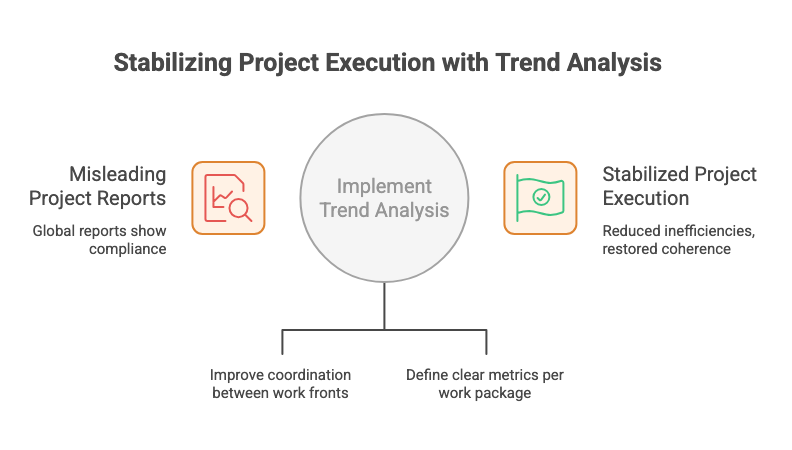
A project with multiple work fronts and high pressure on deadlines maintained a control system based on periodic reports. The indicators showed compliance with the plan, which generated confidence in the project’s progress.
However, the operation reflected a different reality. Indirect costs were steadily increasing, the team required greater effort to maintain the pace of progress, and activities were beginning to show interferences. These signals were not visible in the global reports.
By incorporating trend-based analysis, it was identified that progress was being sustained through higher resource consumption. Additionally, it was detected that the execution schedule was starting to create lags in billing milestones, affecting the project’s financial stability.
The intervention focused on reorganizing the sequence of activities, improving coordination between fronts, and establishing clear performance metrics per work package. As a result, the project managed to stabilize its execution, reduce inefficiencies, and restore coherence between progress and effort.
DESIGNING PROJECT-PROPORTIONAL CONTROL SYSTEMS
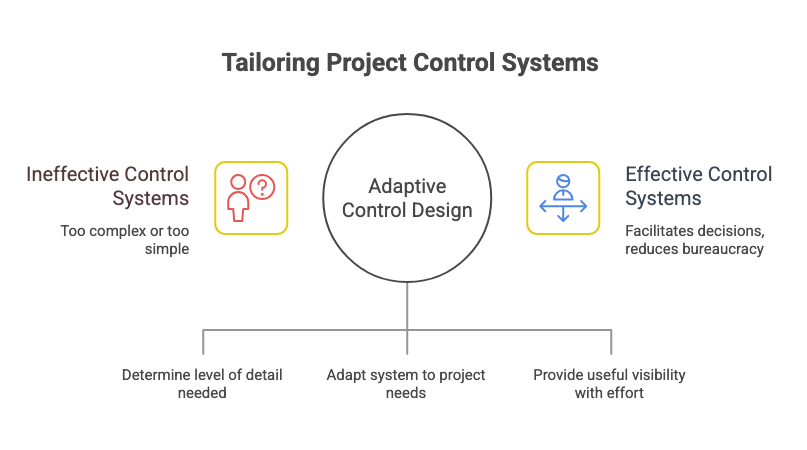
The design of the control system must respond to the nature of the project. Not all projects require the same level of detail or the same tracking structure. The key lies in adapting the system to complexity and risk.
In smaller-scale projects, a simple control based on key indicators and trends may be sufficient.
In more complex projects, a more detailed analysis is required to allow for an understanding of the behavior of each execution component.
An excess of control can be as problematic as its absence. Overly complex systems generate an operational burden without improving decision-making. Conversely, systems that are too simple can hide relevant information.
Effective control is that which provides useful visibility with the least possible effort. Its objective is to facilitate decisions, not to generate bureaucracy.
CURRENT FRAMEWORK OF PROJECT MANAGEMENT
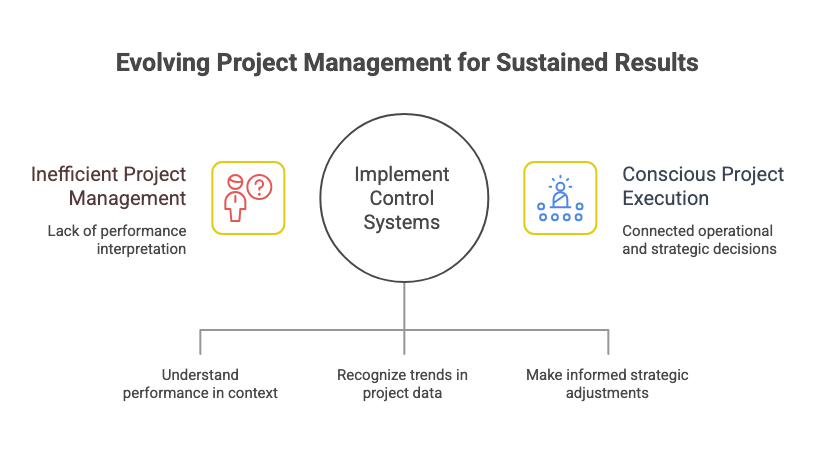
Current project management demands control systems that allow for the interpretation of performance and timely action. The ability to analyze information in context, identify patterns, and adjust decisions becomes a key element for sustaining results in demanding environments.
The discipline is evolving toward approaches where execution is managed more consciously, connecting operational information with strategic decisions.
REFERENCES
International Organization for Standardization. (2020). ISO 21502: Project, programme and portfolio management — Guidance on project management. ISO. https://www.iso.org
McKinsey & Company. (2015). Delivering large-scale IT projects on time, on budget, and on value. https://www.mckinsey.com
Harvard Business Review. (2017). Why projects fail and how to avoid it. Harvard Business Publishing. https://hbr.org