
Project Monitoring And Control: Keys To Track Progress And Deliver Results
VALUE PROPOSITION
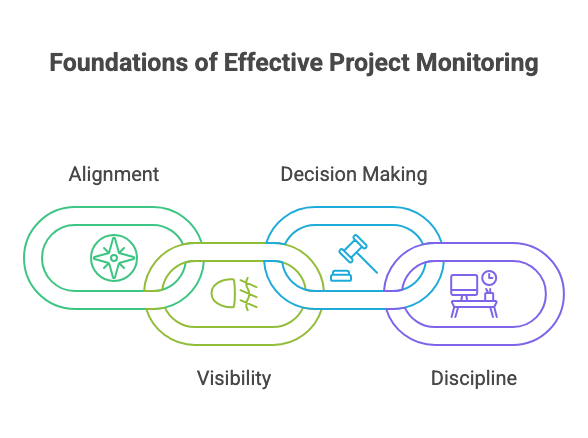
Project monitoring and control become truly effective when it helps teams understand how execution is evolving and how decisions influence results. It goes beyond checking progress against a plan and focuses on maintaining alignment between what is expected and what is being delivered. This allows teams to act with greater clarity and adjust their approach when needed while maintaining consistency in how work is performed.
A structured monitoring approach improves visibility and helps detect issues early. When supported by clear indicators and consistent communication, it strengthens decision-making, reduces uncertainty, and improves the ability to deliver results on time and with the expected level of quality. This approach also creates a more disciplined execution environment where information is used to guide actions rather than simply describe outcomes.
PROJECT MONITORING AND CONTROL AS A CONTINUOUS PROCESS
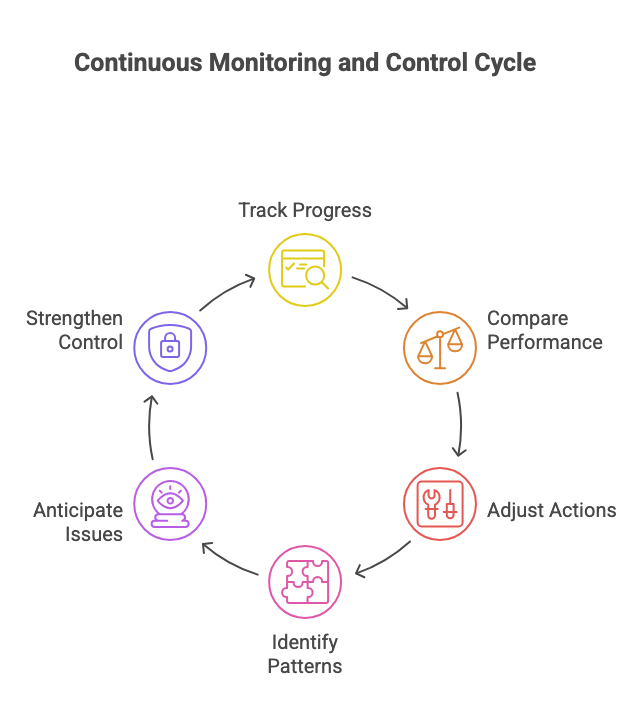
Monitoring and control should be understood as an ongoing activity that supports the project throughout its execution. It involves tracking progress, comparing actual performance with planned expectations, and adjusting actions when necessary. This continuous approach ensures that the project remains aligned with its objectives and that deviations are addressed before they escalate.
International standards such as ISO 21502, developed by the International Organization for Standardization to provide global guidance on project management practices, highlight that monitoring must support decision-making and not be limited to reporting progress. This reinforces the need for continuous oversight during execution and the importance of maintaining visibility across all stages of the project.
As the project evolves, the information collected becomes more valuable. It helps identify patterns, understand performance trends, and anticipate potential issues based on how the work is progressing. This ongoing visibility strengthens control and allows teams to adjust with better timing and context.
PLANNING AS THE FOUNDATION FOR EFFECTIVE PROJECT MONITORING
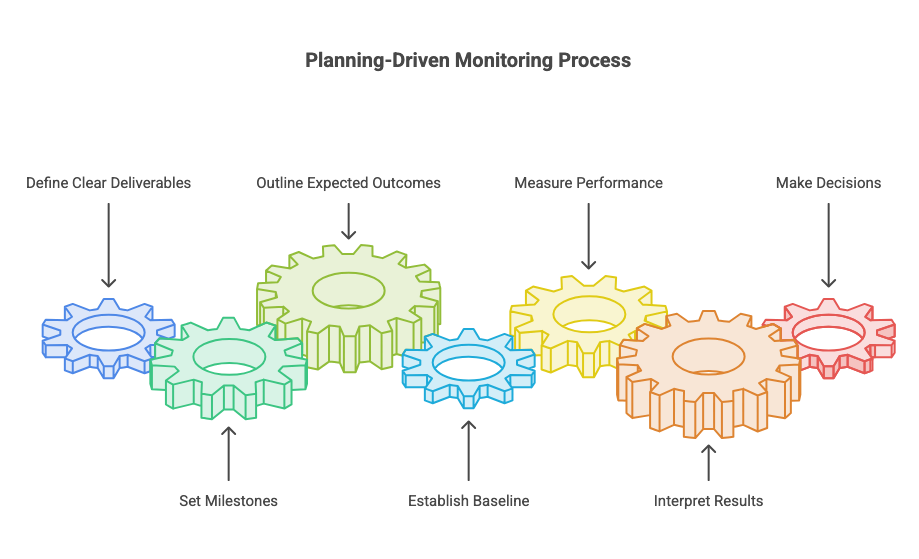
Effective monitoring depends on having a well-defined plan. Clear deliverables, milestones, and expected outcomes provide the reference needed to evaluate progress. Without this structure, monitoring becomes inconsistent and difficult to interpret, limiting its value for decision-making.
Project management approaches described by Harold Kerzner, a recognized expert in planning and control practices, explain that performance can only be measured accurately when a clear plan exists. His work emphasizes that planning establishes the baseline that allows monitoring to be meaningful and actionable.
When planning is incomplete, monitoring loses effectiveness and creates ambiguity in how performance is interpreted. Strengthening the plan helps restore clarity and improves the ability to track progress. It also supports better coordination among teams and aligns expectations across stakeholders.
USING TOOLS TO IMPROVE PROJECT MONITORING VISIBILITY
Tools play an important role in helping teams understand project performance. They allow information to be organized and presented in a way that supports decision-making and improves coordination across the project. Their value comes from making complex data easier to interpret and act upon.
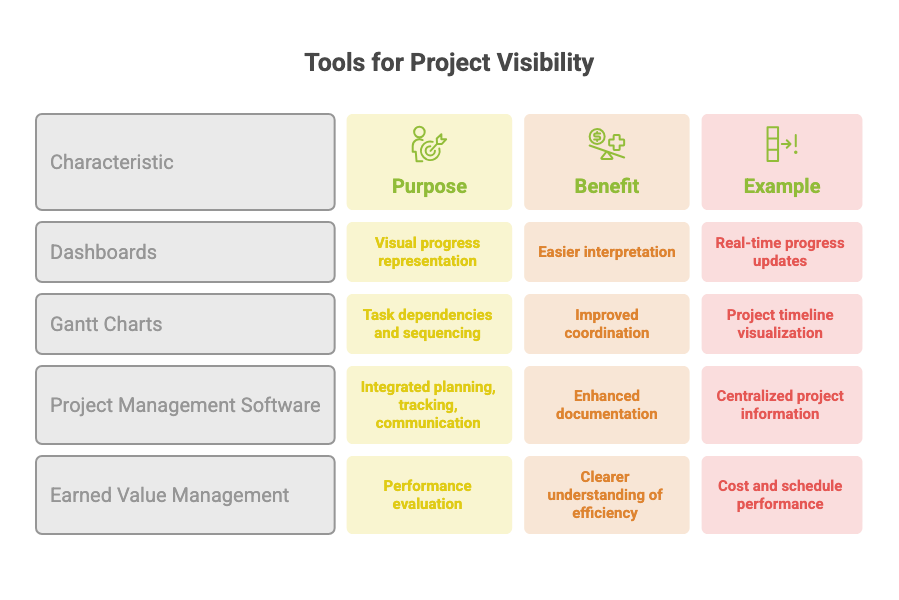
Common tools include dashboards that provide a visual representation of progress and highlight deviations, Gantt charts that show task dependencies and sequencing, and project management software that integrates planning, tracking, and communication. These tools also support documentation and maintain traceability of changes throughout the project lifecycle.
Additional techniques, such as Earned Value Management, help evaluate performance by comparing planned value with actual progress and resource consumption. This provides a clearer understanding of efficiency and allows teams to identify gaps between expectations and execution.
The Project Management Institute PMI, a US-based organization that develops widely used project management standards, highlights that effective monitoring depends on having reliable data and clear visibility of performance. This reinforces the role of tools as enablers of better decision-making rather than as isolated solutions.
PERFORMANCE MEASUREMENT AND PROJECT MONITORING INDICATORS
Measuring performance requires indicators that reflect how the project is progressing in terms of time, cost, and quality. These indicators provide a structured way to evaluate whether the project is meeting its objectives and maintaining alignment with expectations.
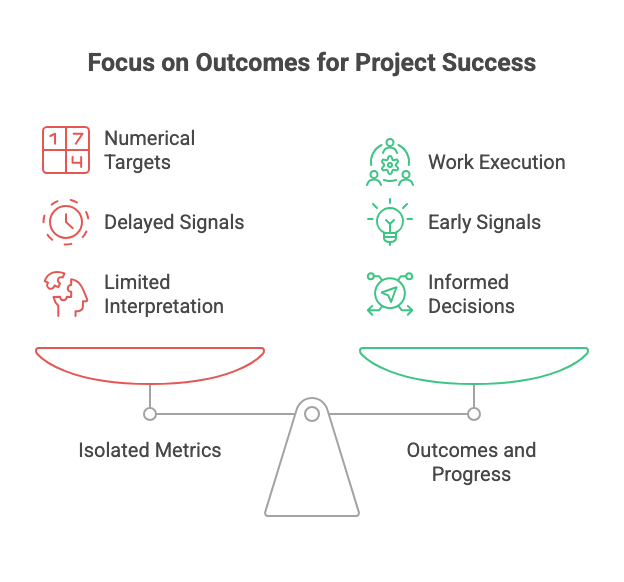
ISO 21502 explains that performance measurement should focus on outcomes and progress rather than isolated metrics. This approach encourages teams to look at how work is being executed and how results are being achieved rather than focusing only on numerical targets.
Well-defined indicators help identify trends and provide early signals of potential issues. When applied consistently, they allow teams to compare performance over time and understand whether corrective actions are needed.
When indicators are clear and relevant, they improve the ability to interpret results and support more informed decisions. This strengthens control and improves overall project performance.
COMMUNICATION AS A KEY ELEMENT OF PROJECT MONITORING
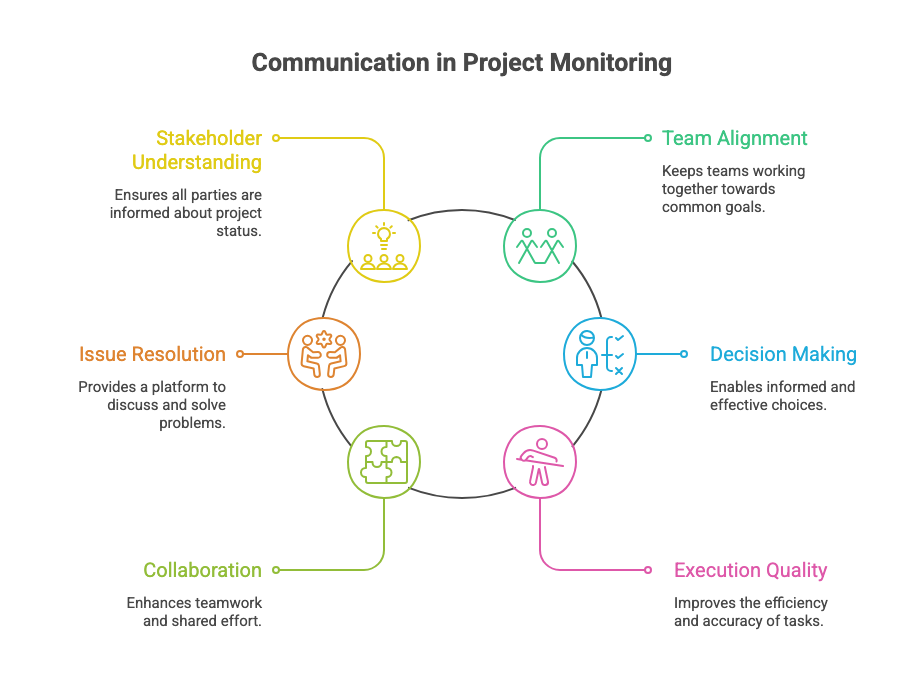
Monitoring is closely linked to communication. Information must be shared clearly and consistently so that all stakeholders understand the project status and the actions required to maintain alignment.
Regular meetings, progress reports, and structured communication channels ensure that information flows across the project. These practices help teams stay aligned and provide a space to discuss issues and define next steps.
The Project Management Institute PMI highlights that communication management is essential for effective control, as it ensures that relevant information reaches the right people at the right time. Without this clarity, even accurate data cannot support decision-making effectively.
Clear communication strengthens collaboration and improves execution quality. It reduces misunderstandings and allows teams to respond more effectively to changes and challenges.
ROLES AND DECISION STRUCTURE IN PROJECT MONITORING
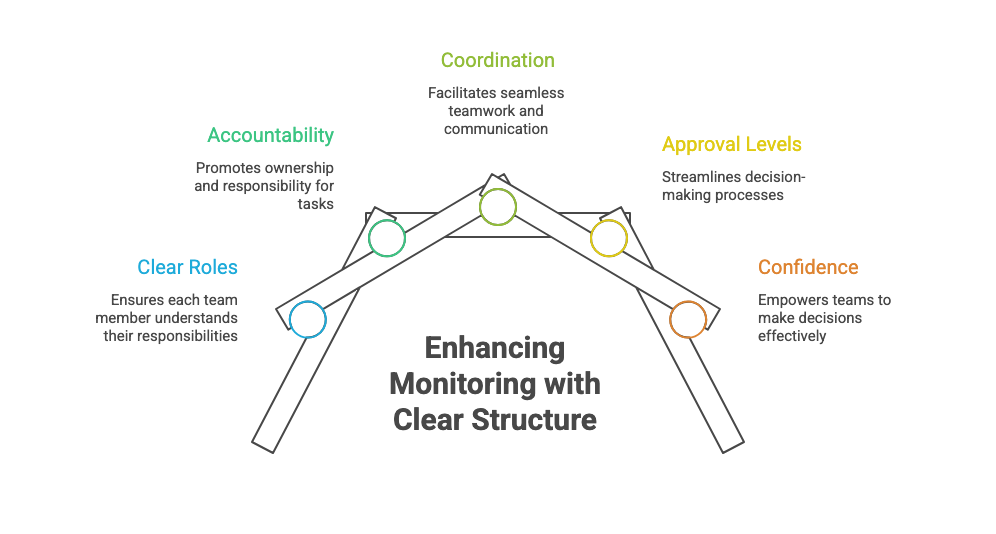
Clear roles and responsibilities are essential for effective monitoring. Each team member must understand their role and how their work contributes to the overall project. This clarity improves accountability and supports better coordination.
Assigning responsibility for monitoring activities ensures that the process remains active and organized. It also helps maintain consistency in how information is reviewed, interpreted, and used to support decisions.
Defining approval levels in advance allows decisions to be made more efficiently and reduces delays when changes are required. This structure ensures that actions are taken within a clear framework.
A well-defined decision structure allows teams to respond with confidence and maintain control over execution even when conditions change.
PROJECT MONITORING AND CONTROL IN PRACTICE
A digital transformation initiative aimed to improve customer experience across multiple service channels required both structured planning and flexible execution. The project initially relied on a detailed plan with predefined milestones and formal reporting cycles. Monitoring focused on tracking progress against these milestones, while user feedback remained limited in the early stages.
As development progressed, the team observed that completed features did not fully align with user expectations. Adjustments were required later in the process, increasing effort and affecting timelines. This situation reflected a gap between planned outcomes and actual value delivered due to limited feedback during execution.
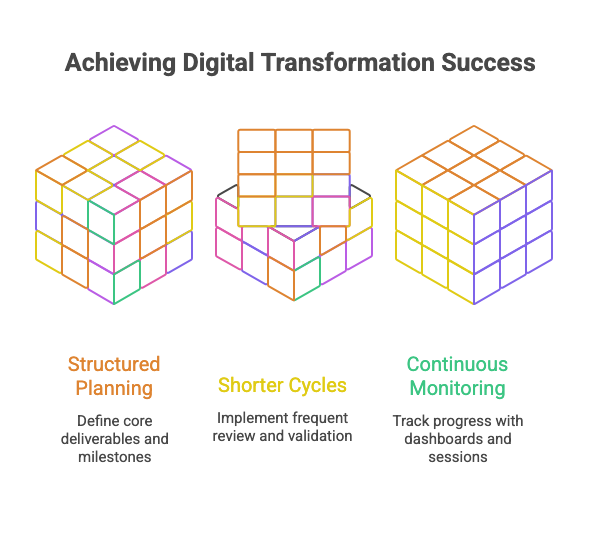
To address this, the team maintained structured planning for core deliverables while introducing shorter execution cycles that allowed frequent review and validation. Monitoring shifted toward continuous tracking supported by dashboards and regular alignment sessions where teams reviewed progress and incorporated feedback.
These changes improved visibility and reduced rework. Issues were identified. Earlier decisions were based on current information, and alignment with user expectations increased. The project achieved more stable execution and delivered results that better matched business needs.
ADAPTABILITY IN PROJECT MONITORING AND CONTROL
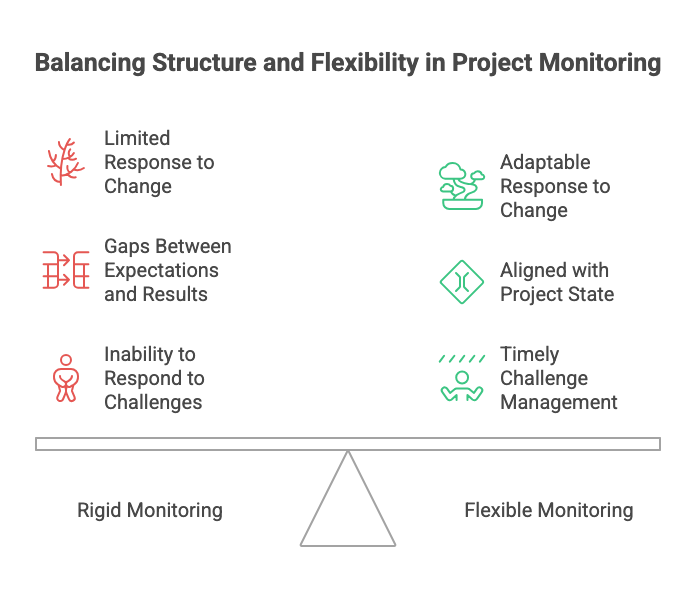
Projects operate in changing environments, and monitoring must adapt to these conditions. As priorities shift and new information becomes available, the monitoring approach must remain flexible to stay effective.
A rigid approach limits the ability to respond to change and creates gaps between expectations and results. In contrast, a flexible monitoring system allows teams to adjust their methods while maintaining control.
This adaptability ensures that monitoring remains aligned with the actual state of the project. It also allows teams to respond to challenges in a timely and structured way.
Maintaining this balance between structure and flexibility is essential to sustaining effective control throughout execution.
MONITORING AND CONTROL AS A DRIVER OF PROJECT SUCCESS
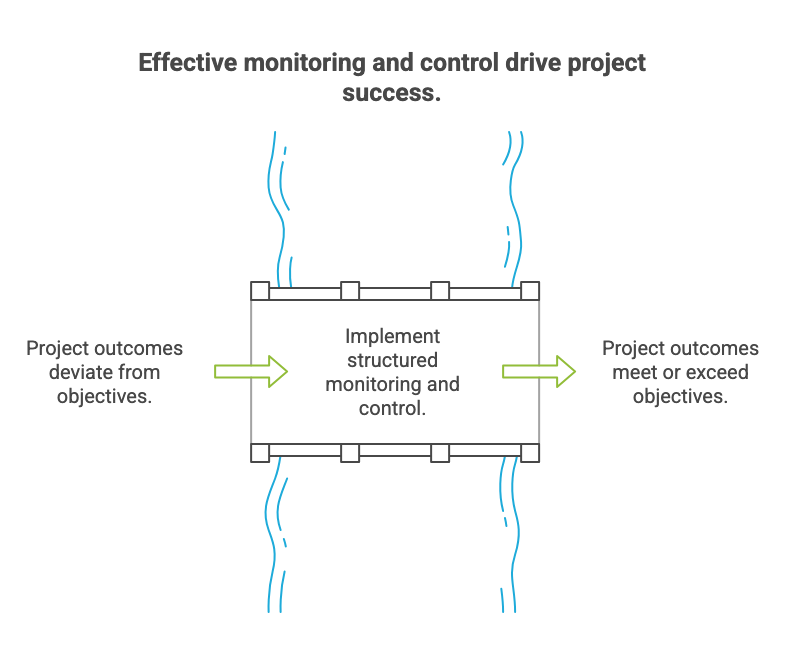
Monitoring and control support the ability to deliver results by maintaining alignment between execution and objectives. It provides the information needed to act with clarity and respond to challenges as they arise.
Project management frameworks, including those developed by Kerzner and the Project Management Institute PMI show that effective control is directly linked to project success. These approaches emphasize the importance of continuous evaluation and informed decision-making.
When monitoring is applied with structure and purpose, it improves coordination, strengthens performance, and increases the likelihood of achieving expected outcomes.
This makes monitoring and control a central element in the successful delivery of projects across different industries and contexts.
CURRENT PERSPECTIVE ON PROJECT MANAGEMENT
Project management today requires a balanced approach that connects planning, monitoring, and continuous adjustment. The ability to understand how execution is progressing and to respond with timely decisions has become essential, especially in environments where conditions change and information evolves during the project. Monitoring is no longer a support activity, but a central element that guides execution.
In this context, the focus has shifted from static control to dynamic interpretation of performance. Teams are expected to go beyond tracking progress and use information to understand how work is being executed, how resources are being used, and what adjustments are needed to maintain alignment with objectives. This reinforces the role of monitoring as a tool for decision-making rather than a reporting mechanism.
This perspective is particularly relevant in entrepreneurial environments, where projects often start with limited structure and high uncertainty. In these cases, monitoring helps bring order to execution by providing visibility on progress, resource use, and results. It allows founders and teams to test ideas, validate assumptions, and adjust direction without losing control of the initiative.
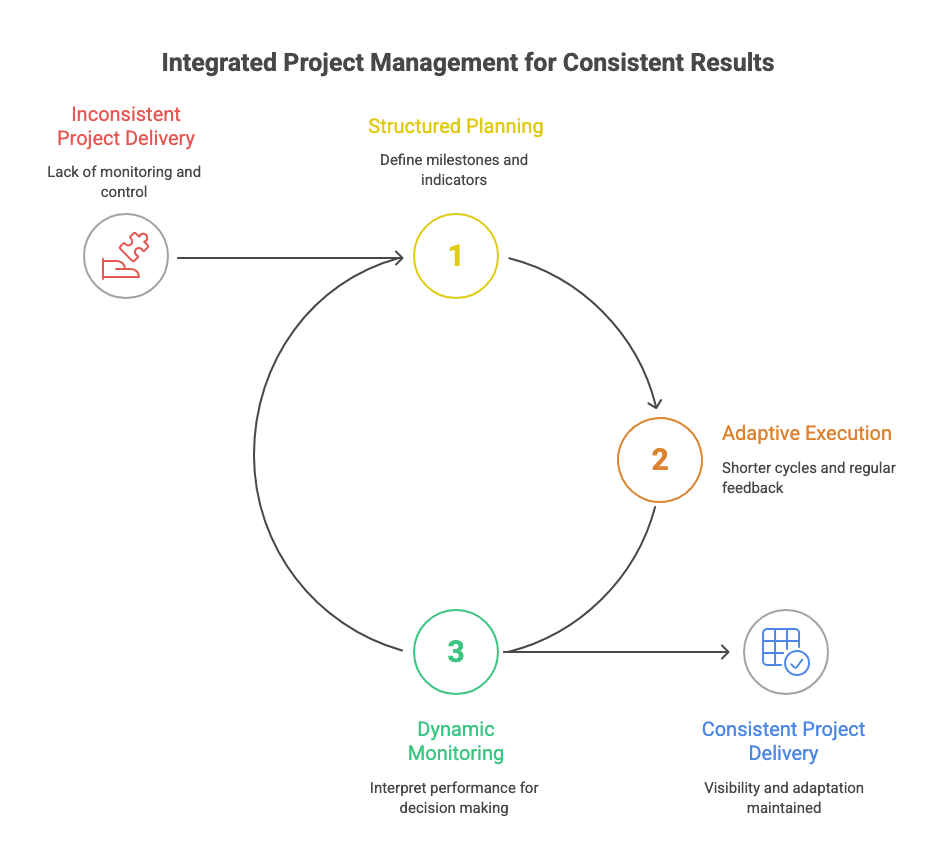
At the same time, relying only on flexible execution can create inconsistencies when the project grows in complexity. For this reason, combining structured planning with adaptive execution becomes a practical solution. Clear milestones, defined indicators, and consistent monitoring provide stability, while shorter execution cycles and regular feedback allow teams to adjust based on real outcomes.
This integrated approach strengthens the connection between monitoring and decision-making. It allows teams to maintain visibility while responding to change, reducing the gap between planned results and actual performance. It also supports earlier identification of issues and more effective use of resources.
Modern project management, therefore, is not about choosing between structure and flexibility. It is about combining both in a way that supports execution. Monitoring plays a central role in this balance, as it provides the information needed to maintain control while enabling adaptation. This makes it a key capability for delivering consistent results across different types of projects.
REFERENCES AND OFFICIAL SOURCES ON PROJECT MANAGEMENT
International Organization for Standardization 2020 ISO 21502 Project Program and portfolio Management, Guidance on Project Management
https://www.iso.org
Project Management Institute 2021 A guide to the project management body of knowledge PMBOK Guide 7th edition
https://www.pmi.org
Kerzner H, 2017 Project management: A systems approach to planning, scheduling, and controlling, Wiley