
INTEGRATING AGILE AND TRADITIONAL APPROACHES IN A HYBRID FRAMEWORK: KEYS TO PROJECT EXECUTION
VALUE PROPOSITION
The integration of agile and traditional approaches within a hybrid framework responds to a specific need in modern project management: adapting execution to diverse contexts without losing coherence, control, or responsiveness. This approach allows for clearly structured planning while incorporating iterative dynamics that enable continuous adjustment, resulting in management that is more aligned with the operational reality of each initiative.
The deliberate combination of predictive practices with iterative dynamics strengthens decision-making, improves visibility into progress, and enables more structured change management. This integration creates a balance between discipline and adaptability, facilitates team coordination, and contributes to more consistent value delivery aligned with real business needs.
HYBRID FRAMEWORK PROJECT MANAGEMENT IN DYNAMIC ENVIRONMENTS
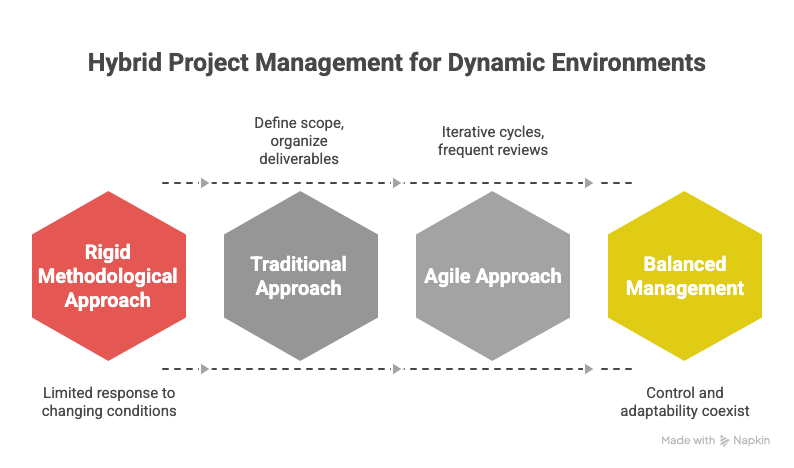
Project management no longer operates in stable and predictable environments. Today, most initiatives take place in contexts where conditions change, requirements evolve, and business expectations are adjusted during execution. In this scenario, the rigid application of a single methodological approach tends to impose limitations on a project’s ability to respond effectively. The integration of agile and traditional approaches emerges as a way to address this reality with greater coherence.
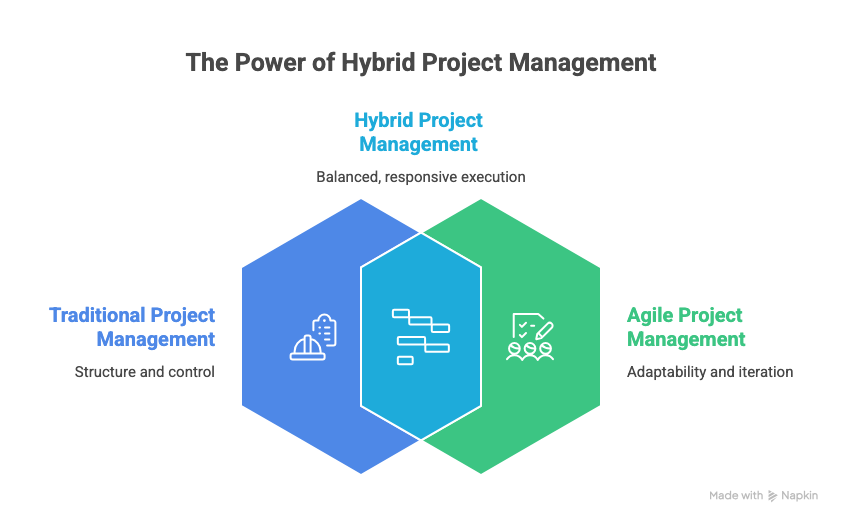
The traditional approach has proven its value in the initial structuring of a project. It allows for the clear definition of scope, the organization of deliverables, the establishment of timelines, and the allocation of resources in an orderly manner. This stability is essential for projects that require control, regulatory compliance, or coordination across multiple areas. However, when applied exclusively, it can create challenges in adapting to changes during execution.
The agile approach introduces a different dynamic. Through iterative cycles, frequent reviews, and continuous feedback, it enables the project to adjust as it evolves. This adaptability improves alignment with user needs, facilitates early validation of solutions, and allows for changes to be incorporated without completely disrupting execution.
The integration of both approaches within a hybrid framework makes it possible to leverage the strengths of each. Planning retains its structure, while execution gains flexibility. This combination results in more balanced management, where control and adaptability coexist coherently.
This perspective aligns with the evolution of standards from the Project Management Institute (PMI), a globally recognized authority whose PMBOK® Guide acknowledges the integration of predictive, adaptive, and hybrid approaches as a response to today’s complexity. PMI is a professional organization founded in the United States in 1969, dedicated to advancing and standardizing project management practices worldwide.
HYBRID FRAMEWORK AS AN ADAPTIVE MODEL IN PROJECTS
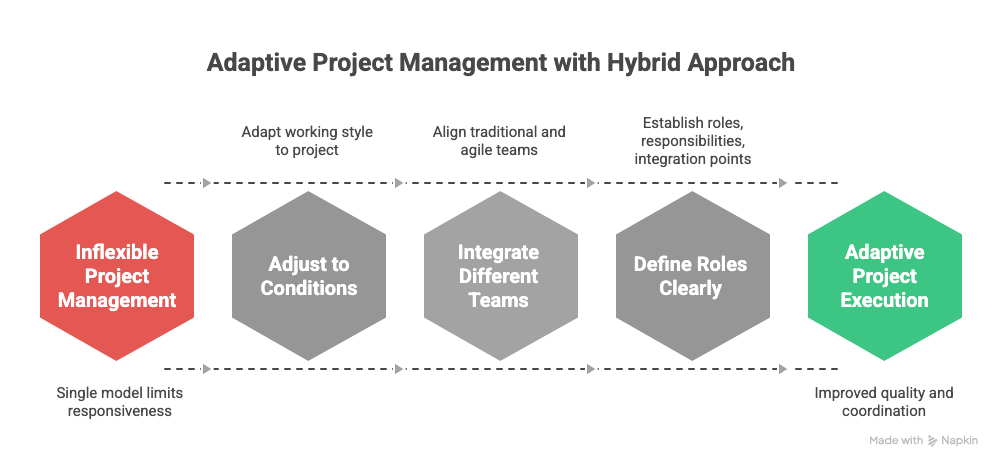
The adoption of a hybrid framework responds to the need to adapt project management to its specific conditions. Each initiative has unique characteristics that influence its execution, such as the level of uncertainty, client interaction, technical complexity, or organizational environment. Attempting to manage all projects under a single model limits responsiveness and can lead to operational inefficiencies.
The hybrid framework makes it possible to adjust the way of working according to these conditions. In projects where the scope is clearly defined, structured planning provides stability. In those where knowledge develops progressively, iterative dynamics allow teams to learn and adjust direction. This methodological adaptability becomes a key factor in improving execution quality.
The flexibility of the hybrid approach also facilitates the integration of different teams. In many organizations, areas operating under traditional frameworks coexist with others that adopt agile practices. The ability to align both approaches within a single project improves coordination and reduces operational friction, allowing each team to contribute based on its expertise.
This adaptability does not mean a lack of structure. On the contrary, it requires greater clarity in defining roles, responsibilities, and integration points. In this regard, frameworks such as PRINCE2 provide a structured foundation for management, particularly in organizations that require control, governance, and well-defined processes. This allows the flexibility of the hybrid framework to be built on a solid base.
WHAT IS PRINCE2?
PRINCE2 (Projects IN Controlled Environments) is a structured project management framework originally developed in the United Kingdom in the late 1980s, with a major update in 1996 that enabled its broader adoption across various sectors.
INTEGRATION WITH THE PROJECT LIFE CYCLE
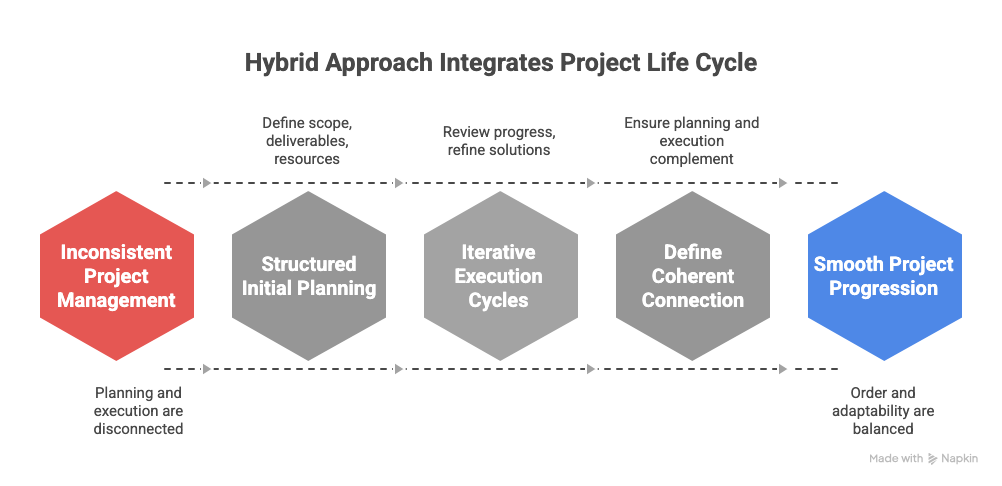
The hybrid framewok takes shape through the way the project life cycle is organized. In the initial stages, structured planning makes it possible to define scope, establish deliverables, and organize resources. This foundation provides a clear framework that supports project direction and coordination across different areas.
Building on that base, execution can be organized through iterative cycles. These cycles allow teams to review progress, refine solutions, and respond to new conditions without disrupting the overall structure. Iteration becomes a tool to improve the quality of outcomes and keep the project aligned with business expectations.
The integration of both approaches requires coherence. It is not about applying methodologies in parallel, but about defining how they connect within the project life cycle. This connection ensures that planning and execution complement each other, avoiding inconsistencies or duplication of effort.
When this integration is done correctly, the project progresses more smoothly. The initial structure provides order, while iteration enables adaptability. This combination strengthens project consistency and improves the quality of its results.
BALANCE BETWEEN CONTROL AND FLEXIBILITY IN PROJECTS
One of the greatest challenges in project management is maintaining the balance between control and adaptability. Excessive control can limit responsiveness, while flexibility without structure can lead to disorder. The hybrid approach enables this balance to be managed more effectively.
Clarity on which aspects of the project require control is essential. Elements such as scope, budget, and critical deliverables must remain within a defined structure. This ensures that objectives are met and helps prevent unnecessary deviations.
At the same time, there are areas where adaptability adds value. User interaction, solution development, and change management benefit from a more flexible dynamic. Allowing adjustments in these areas improves both the quality of outcomes and the project’s ability to respond effectively.
This balance is not achieved automatically. It requires judgment, experience, and continuous awareness of the context. Project leadership must be capable of adjusting the approach as the initiative evolves, while maintaining coherence in execution.
CONTINUOUS VALUE DELIVERY IN HYBRID PROJECTS
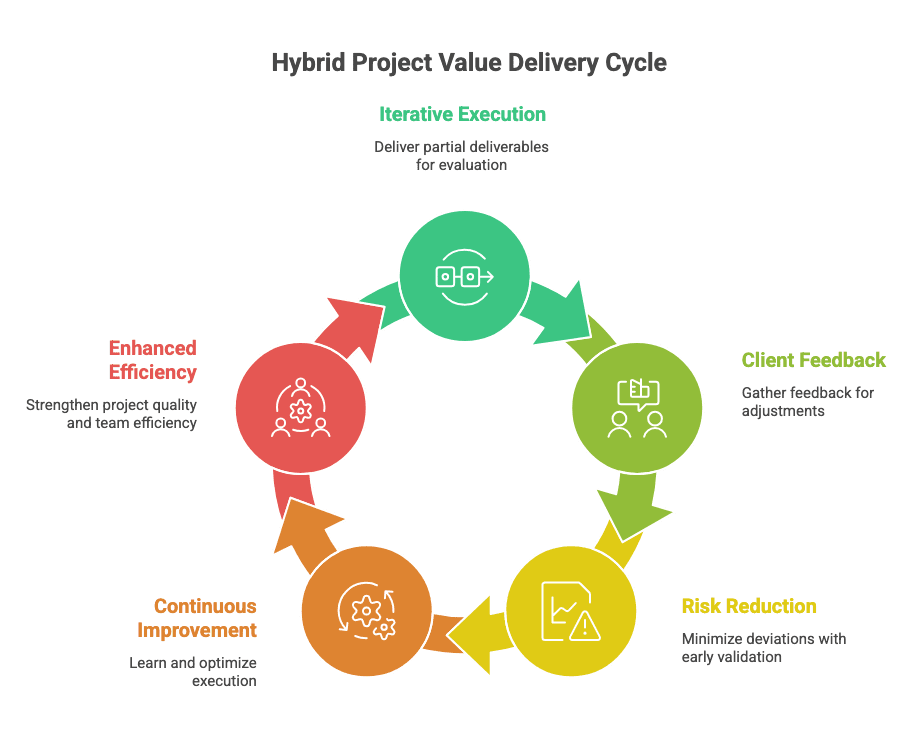
The integration of approaches also influences how a project delivers value. Instead of concentrating results at the end, iterative execution enables partial deliverables that can be evaluated and adjusted progressively.
This dynamic improves the relationship with the client or user. It allows decisions to be validated in early stages, reduces the risk of deviations, and enables the project to be adjusted as new information emerges. Value delivery becomes a continuous process, more closely aligned with real needs.
Continuous improvement is a natural part of this approach. Each iteration creates opportunities to learn, refine, and optimize execution. This process strengthens project quality and enhances team efficiency.
The result is a management approach more closely connected to the value the project aims to generate. Execution is no longer linear but becomes a dynamic process where adaptation and learning play a central role.
As a reference, analyses by the Standish Group through the CHAOS Report have shown that projects integrating iterative dynamics within structured frameworks achieve higher levels of performance, reinforcing the relevance of combining both approaches.
The Standish Group is a research firm founded in the United States in 1985, specializing in project performance analysis, particularly in technology and organizational transformation environments. It is best known for the CHAOS Report, a periodic study that evaluates projects based on variables such as schedule, cost, scope, and customer satisfaction.
CASE STUDY: HYBRID FRAMEWORK
A service-sector organization decided to transform its operating model through the use of digital solutions aimed at improving user experience and internal efficiency. The initiative involved multiple areas, with critical operational dependencies and requirements that were not fully defined from the outset, creating a high exposure to adjustments during execution.
In its initial phase, the project was structured under a traditional approach. A broad scope was defined, a detailed schedule was established, and resources were allocated based on comprehensive planning. However, during execution, frequent changes in requirements began to emerge, along with delays in internal validations and rework caused by solutions that did not fully meet user needs.
The team continued progressing according to plan, but with deliverables that required subsequent corrections. This led to an accumulation of pending work, loss of operational momentum, and increasing pressure on delivery timelines.
In response, the organization decided to shift toward a hybrid framework. Structured planning was maintained as the foundation for scope control, cross-functional coordination, and the management of critical dependencies. At the same time, execution was reorganized into shorter iterative cycles, incorporating regular review sessions with key users and business stakeholders.
This adjustment enabled continuous validation of progress, refinement of functionalities before scaling development, and prioritization of deliverables based on the real value they provided.
The impact of this shift became evident in the project’s progression. Decisions were no longer based solely on initial assumptions but increasingly driven by validated insights obtained during execution. Rework decreased as deviations were identified earlier, preventing costly adjustments in later stages. Coordination across teams improved through more frequent checkpoints and enhanced visibility into progress.
As a result, the team regained operational momentum, reduced uncertainty during execution, and delivered solutions more closely aligned with business expectations. The improvement did not come from changing the project’s objective, but from transforming how its execution was managed.
HYBRID FRAMEWORK KEY INSIGHTS
- The hybrid approach makes it possible to identify important lessons learned. One of the main takeaways is the importance of adapting the methodology to the project’s context. Management should respond to the reality of the initiative rather than rely on the rigid application of a single model.
- Clarity in how approaches are integrated is essential. Defining how practices connect helps maintain coherence in execution and prevents operational conflicts.
- Leadership also plays a critical role. The ability to interpret context and adjust the way of working directly influences the success of a hybrid framework.
- Change management is another key element. Adopting this approach requires adjustments in organizational culture and in how teams operate.
HYBRID APPROACH AS AN EVOLUTION
The integration of agile and traditional approaches represents an evolution in how projects are managed. This approach enables the development of management models that are more aligned with the realities of today’s environments.
The evolution of international standards and project management frameworks reflects this transition toward more flexible models, where adaptability becomes a key element for sustaining results.
Global project performance analyses also support this direction, showing that integrating approaches improves execution capabilities in changing environments.
There is a clear shift toward more adaptive models, where the integration of approaches allows organizations to respond effectively to dynamic contexts. International organizations, certifying bodies, and specialized studies continue to develop guidelines, standards, and insights that strengthen professional practice and support decision-making in real execution environments.
In this context, the hybrid approach is consolidating itself as a management model that integrates planning, execution, and adaptability within a single structure, delivering greater consistency and sustainability in results.
REFERENCES
- Standish Group. (2020). CHAOS Report 2020: Beyond Infinity. The Standish Group International, Inc.
https://www.standishgroup.com - Project Management Institute. (2021). A Guide to the Project Management Body of Knowledge (PMBOK® Guide) (7th ed.). Project Management Institute.
https://www.pmi.org/pmbok-guide-standards - PeopleCert. (2023). Managing Successful Projects with PRINCE2 (7th ed.). PeopleCert.
https://www.peoplecert.org/browse-certifications/project-programme-and-portfolio-management/PRINCE2