
Risk Management in Project Planning: A Strategic Approach To Achieving Sustainable Results
Value Proposition
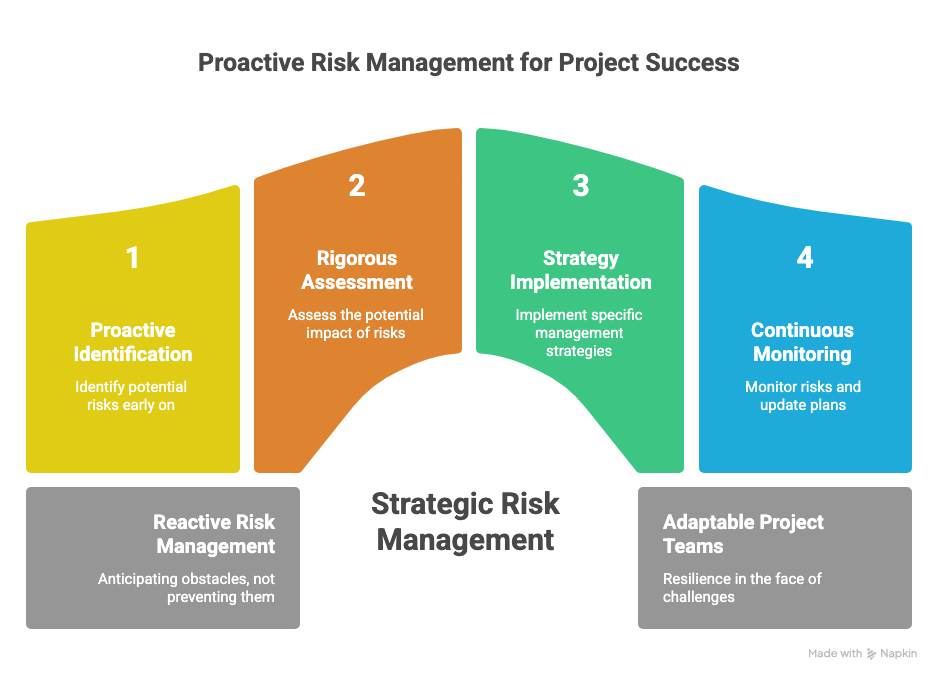
Risk management in contemporary project planning is not simply about anticipating obstacles, but about adopting a proactive and strategic mindset. Proactive identification, rigorous assessment, implementation of management strategies, and continuous monitoring are essential for the success of any project in today’s landscape.
Each strategy must be specific to the risk in question and designed to minimize its potential impact on the project; moreover, it is essential to have clear response plans in place in case a risk materializes, remembering that risk management is not a static process, but a dynamic one.
These elements form a solid framework that ensures project teams’ adaptability and resilience in the face of emerging challenges.
Risk Management from Planning: A Strategic Vision with Sustainable Results
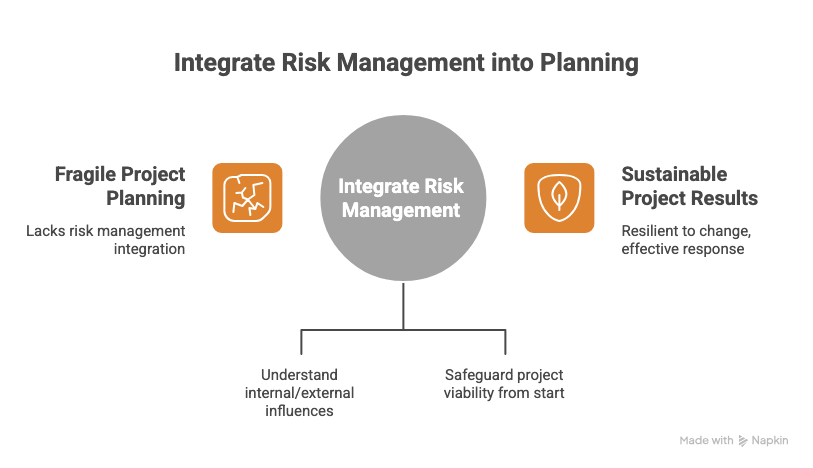
In today’s project management landscape, one of the most common mistakes does not occur during execution, but much earlier, during the planning phase. Many initiatives begin with clear objectives, demanding timelines, and pressure to show early progress, yet fail to truly and structurally incorporate risk management as part of the planning process. The result is often a project that appears well-organized but is fragile in the face of change, vulnerable to deviations, and lacking the ability to respond effectively when unforeseen situations arise.
Planning is no longer just about defining activities, timelines, costs, and responsibilities. Effective planning also means recognizing that every project operates within a dynamic environment, influenced by both internal and external variables that can impact its performance, continuity, and overall contribution to the business. Therefore, integrating risk management into the planning phase should not be seen as a methodological add-on, but as an essential practice to strengthen decision-making and safeguard the project’s viability from the very beginning.
Risk Management Is a Leadership Capability, Not a Documentation Formality
For many years, in numerous organizations, risk management was treated as a procedural requirement: a matrix to be filled out, a section of the project plan, or a one-time review exercise conducted at the beginning. However, experience has shown that this approach is insufficient for today’s challenges. In projects and initiatives, risk cannot be addressed as an isolated or static element; it must be embraced as an integral part of the project’s strategic direction.
Managing risks involves identifying conditions that may affect objectives, evaluating their potential impact, analyzing their likelihood, assigning responsibilities, defining response plans, and maintaining continuous monitoring to enable timely decision-making adjustments. But beyond the technical process, its true value lies in fostering a more mature way of thinking about projects. It shifts planning away from ideal assumptions and toward building scenarios grounded in reality, anticipation, and resilience.
A Project Can Be Well Structured Yet Still Exposed If Risks Are Not Integrated
This becomes clear when looking at real-world cases. It is common to find projects that begin with a well-defined scope, an approved baseline schedule, an authorized budget, and visible team commitment. On the surface, everything appears to be under control. However, as execution progresses, situations begin to emerge that impact performance:
Delays in approvals, resource constraints, incomplete technical information, excessive dependence on critical suppliers, regulatory changes, shifts in business priorities, or delayed responses from key areas.
In most of these cases, the issue is not that the risks were impossible to foresee. The problem is that they were not analyzed in sufficient depth or integrated into the planning phase promptly. In other words, the project was planned as if the context were stable, when in reality it operated within a system of high interaction, uncertainty, and potential change.
This gap between the theoretical plan and operational reality is precisely where risk management must play its strongest role.
The Quality of Planning Depends on How Well Risks Are Interpreted
Effective risk management begins with serious, contextualized identification. It is not enough to list threats in a general way. A well-defined risk must include its cause, event, consequence, triggering conditions, warning signals, and a clear understanding of how it may impact the project in terms of schedule, cost, scope, quality, safety, compliance, or expected value.
This review should encompass both internal and external factors. From an internal perspective, it is important to assess the actual availability of resources, the level of scope definition, the quality of baseline information, process maturity, cross-functional coordination, and the team’s responsiveness. On the external side, variables such as market conditions, availability of contractors and supplies, regulatory changes, social dynamics, economic factors, technological pressures, and any other elements that may influence the project environment must be considered.
The true value of this analysis lies not only in identifying risks but in understanding them deeply enough to integrate them into key decision-making. When this happens, planning gains depth, consistency, and adaptability.
Risk Response Plans Strengthen Decision-Making
Once risks have been identified and analyzed, the truly decisive step is defining how they will be addressed. This is where mature management makes a clear difference. A risk response plan should not be a generic list of good intentions, but rather a set of concrete and feasible actions designed to handle each situation according to its nature, priority, and potential impact on the project.
In some cases, the response will involve avoiding conditions that create unnecessary exposure. In others, it may require transferring certain responsibilities, consciously accepting the risk based on predefined criteria, escalating decisions to higher levels, or preparing specific contingency and recovery actions. What matters most is ensuring that the response is aligned with the project’s context, its execution strategy, and the organization’s actual capacity to act.
When done properly, risk management shifts from being a late-stage reaction to becoming a true management tool. It helps define priorities, adjust sequencing, strengthen governance, protect critical milestones, and prepare the team to respond more coherently as conditions evolve.
Risk Management Requires Resources, Technology, Leadership, and Coordination
One of the most common shortcomings in practice is treating risks as a parallel issue, separate from resource allocation, contractual strategy, schedule control, or stakeholder management. In reality, risk management only delivers real value when it directly influences the core decisions of the project.
If there are critical procurement dependencies, this must be reflected in the sequence of activities, in time buffers, and in early supply oversight. If the project is highly sensitive to scope changes, governance structures and approval mechanisms must be adjusted from the outset. If the availability of key personnel is limited, the plan must acknowledge this constraint and respond accordingly.
Likewise, the use of technological tools for monitoring, dashboards, scenario simulation, and predictive analysis can significantly enhance visibility, provided there is professional judgment to interpret the information and translate it into timely decisions. None of this works in isolation. Risk management requires genuine collaboration across disciplines.
Technical, operational, financial, regulatory, contractual, social, and technological aspects can rarely be fully understood from a single perspective. For this reason, robust planning depends on open dialogue between areas, clear accountability, and a culture that allows vulnerabilities to be discussed without confusing transparency with weakness. The most resilient projects are not those that appear to have absolute control, but those that develop the ability to recognize early where their sensitive points lie, and how to act upon them.
Resilience Is Built Through Continuous Evaluation and a Vision of Changing Scenarios
One of the most important principles in contemporary management is understanding that risks do not remain static. They evolve as the project progresses, as the environment changes, and as decisions are made. For this reason, risk management cannot be limited to an initial review. It must remain active throughout the entire project lifecycle through continuous monitoring, updating assumptions, tracking warning signals, and periodically reviewing response plans.
This dynamic is what enables resilience. A resilient project does not avoid all difficulties, but one that can absorb impacts, reorganize, and regain direction without losing sight of its strategic objectives. This capability is especially critical in complex initiatives exposed to regulatory pressure, market changes, technological evolution, corporate decisions, territorial conditions, or high dependence on third parties.
At this stage, sustainability and corporate social responsibility also become increasingly relevant. Risks related to the environment, reputation, social impact, ethical compliance, or community engagement can no longer be treated as secondary issues. They are part of the real context in which projects operate and must therefore be integrated into both planning and ongoing management. Ignoring them can compromise not only execution, but also the legitimacy and long-term sustainability of the value created.
Managing Risks from the Planning Stage Is, at Its Core, a Way of Leading Better
At its core, well-executed risk management reflects the level of maturity with which an organization leads its initiatives. It is not about operating from fear or overloading planning with extreme scenarios. It is about leading with sound judgment, recognizing that important projects will always be exposed to uncertainty, and that the true value of leadership lies in preparing teams to act with intelligence, agility, and responsibility.
When risk management is integrated from the planning phase, the project gains clarity, strengthens its decision-making, improves its responsiveness, and better protects its strategic contribution to the business. It no longer depends solely on reaction but instead relies on anticipation, analysis, and coordination. That is the difference between a project that moves forward and one that is truly prepared to sustain results in demanding environments.
Ultimately, managing risks from the planning stage is not a complementary practice; it is an essential condition for executing projects with greater strength, resilience, and long-term vision. In a context where change is constant, and business expectations continue to rise, this capability becomes a decisive advantage in transforming initiatives into sustainable results.